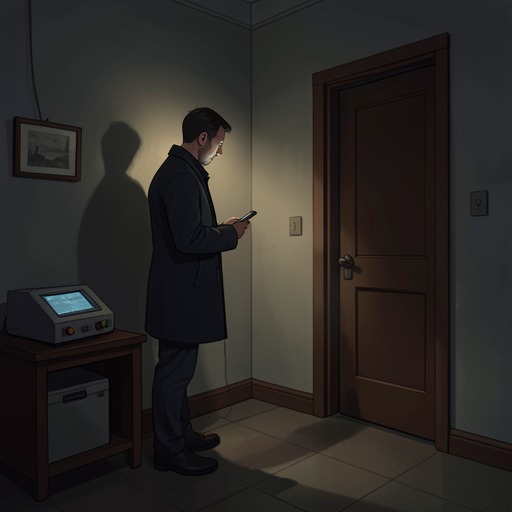
Erik Wilson’s grief and disorientation over Paula’s apparent death
Three SecondsErik Wilson’s grief over Paula’s apparent death is rendered as a rupture in both his attention and his professional routine. After seeing Paula in a prison window and then witnessing the sniper shot and explosion that seem to kill her, Wilson moves through training exercises and ordinary tasks without feeling present in them. His repeated check of five informant phones leads him to a call from a voice he recognizes: Paula reports that the mission is complete and Wojtek has been eliminated in Aspsås Prison. The grief does not simply lift; it is interrupted by the return of the person Wilson believed he had lost.
The apparent death
Wilson’s distress follows a specific sequence of images. Four days before the call, Sven Sundkvist had asked him to drive seventy kilometers to the state line and Jacksonville for lunch. The restaurant had room for laptops displaying security-camera images on its white tablecloths. Wilson had seen Paula’s face in a prison window, then a sniper’s shot and an explosion followed by black smoke. To him, the shot had torn apart a human being. The scene offers no immediate confirmation that Paula survived, and Wilson’s later state is shaped by that visual certainty.
The loss is personal as well as operational. Wilson and Paula had worked together for nearly nine years; Paula had been both his responsibility and his friend. Those two descriptions place him in a double bind: he has the professional burden of being responsible for an informant, but the relationship has also exceeded that role. His experience cannot be contained by the language of an operation or by the habits that normally organize his work.
Absence in routine
The narrative first gives Wilson’s disorientation through what fails to change on the surface. He watches a familiar Secret Service exercise from behind a fence and barbed wire: six figures protect a seventh, shots are fired from two buildings, and the protected figure is carried away in a car. Wilson knows the pattern and its ending; the president survives, as in the same exercise three weeks earlier. The rehearsed rescue continues to work while his own sense of presence does not.
He initially blames the heat, then recognizes that it is not the cause. He has taken part in discussions and exercises over the past few days, but feels absent from the room, his thoughts and energy drained. That inward absence gives the training scene its contrast: Wilson can still follow the staged danger and predict its outcome, yet cannot rejoin the present around him. The exercise repeats a controlled survival while Paula’s fate remains, for Wilson, irreversible and uncontrolled.
Back at the hotel, he showers, lies down in his robe, reads newspapers, watches television advertisements, and wanders around the room. None of these familiar distractions restores his focus. The thought that he has been burned returns as a stark accusation—"They burned you." It links his private grief to the danger and secrecy of his work, without resolving who betrayed the operation or what has happened to Paula.
The phones and the return of contact
Wilson’s five mobile phones are his links to informants. Checking them once each day is usually enough, but his restlessness leads him to check them again. The repeated inspection is not a new professional procedure so much as a deviation driven by his inability to settle. He lifts and studies the handsets one by one until he reaches the fifth. The phone produces a new fear: someone has found it and called the only number stored there. A tool of covert contact has become evidence that the supposedly dead informant may still be reachable—or that an investigator or pursuer has found the channel.
The call first stretches uncertainty rather than ending it. Wilson listens to the ringing tone three times. When a recognizable voice finally comes through, it says, "Mission completed." The caller adds, "Wojtek eliminated in Aspsås." Wilson lies still, afraid that the speaker will vanish from his hand. His fear makes the phone more than a communications device: it is the fragile point where an apparently closed loss can still be contradicted.
Wilson smiles at the voice, which blends with a repeated announcement over loudspeakers, probably in an airport. The ordinary public sound around the call does not diminish its private force. He had perhaps known, somewhere deep down, or at least hoped; now he knows. He answers, "Or another time, another place." The exchange establishes contact without restoring their former working arrangement or explaining what comes next. Its importance lies in the recognition itself: Paula is alive enough to speak, and the mission Wilson thought had ended in death has reached a different conclusion.
The operation behind the grief
The prison scenes clarify why Paula’s survival is tied to an unusually dangerous undercover mission. At Aspsås Prison, Piet Hoffmann positions himself in the television corner before the other prisoners return. He has studied photographs and backgrounds of the fifteen men in his unit; he chooses a place where he can see them arrive and where they will see him. Rather than wait cautiously in his cell, he takes a seat already associated with another prisoner, picks up marked cards, and begins playing solitaire. His conspicuous confidence is a deliberate introduction to a hostile social order.
At supper, two older prisoners demand to see his papers. Stefan Lygas and Karol Tomasz Penderecki rise to intervene, but Hoffmann signals them to hold back. He accepts the challenge and its test of respect, which is bound up with the prisoners’ shared hatred of sexual offenders. The exchange shows that his prison identity must be performed in public, under scrutiny, rather than secured by official documents alone. Stefan and Karol have already prepared the ground: they have circulated information about Hoffmann’s arrival, charges, associates, and supposed standing with an Eastern European mafia, supported by criminal-record, intelligence, and prison documents obtained through Stefan’s lawyer.
Their usefulness carries a lethal limit. Stefan and Karol are two of four Wojtek members serving long sentences at Aspsås; they help Hoffmann remove competition and take control of the prison drug market, but they would also be his executioners if his identity as Paula were exposed. The possibility of betrayal is therefore not an abstract fear. At one point Hoffmann recognizes that one of the people who should protect or help him has burned him, while prisoners call for Paula from farther away near the showers.
Hoffmann’s first major move in the market is precise: he uses forty-two grams of 30-percent manufactured amphetamine to fell the three main dealers in Aspsås Prison. Reports go to Warsaw and the deputy chief executive, who raise a toast to the next stage. For Wilson, then, the final call carries more than reassurance that Paula survived the blast. It reports the completion of a dangerous undertaking whose progress had depended on secrecy, criminal performance, and close allies whose loyalties were uncertain. The book lets Wilson move from the image of Paula lost in smoke to the sound of a familiar voice, while leaving the intervening survival and the consequences of the operation to unfold beyond this moment.